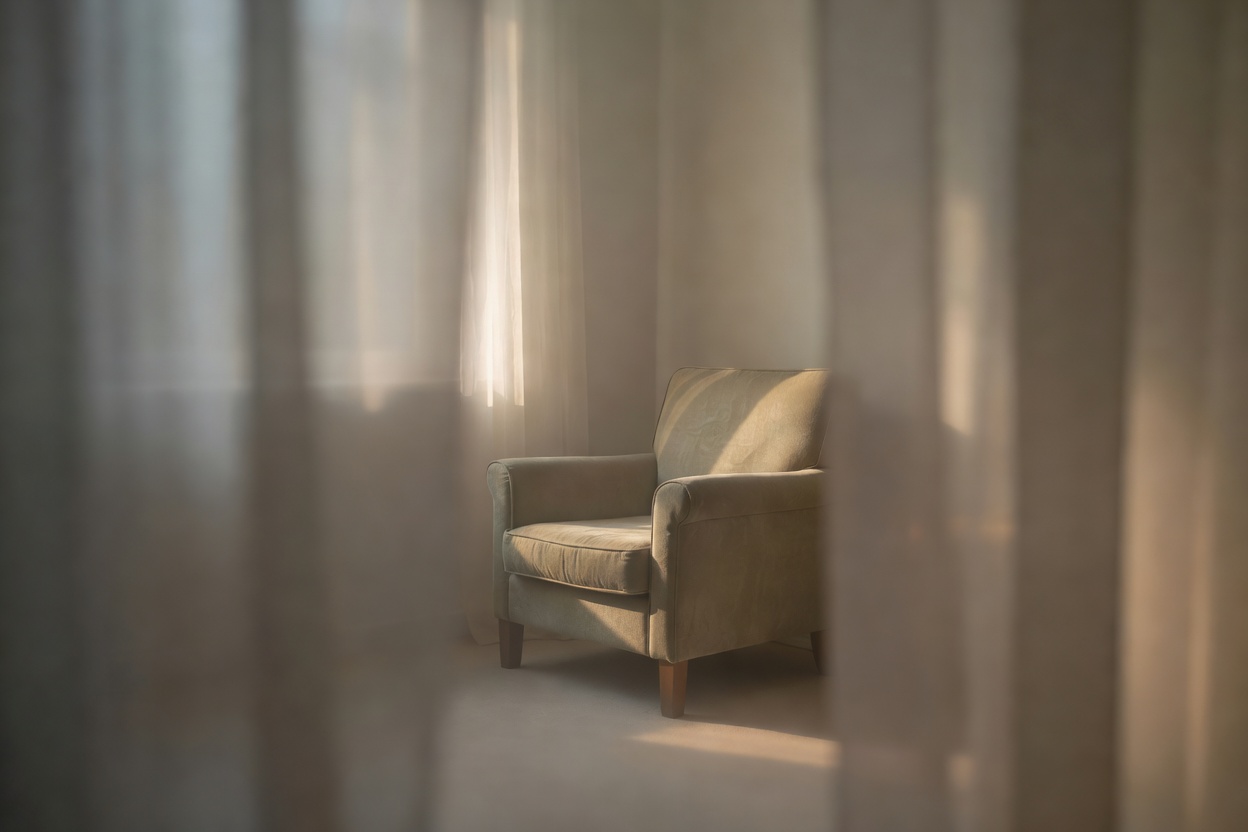
Imagine photographing a person at a kitchen table. A straightforward frame records the person and the table. A more deliberate frame might include the edge of a doorway, a glass close to the lens and a patch of window light behind the chair. The objects are ordinary; their arrangement creates distance, privacy and expectation.
Composition is not the act of placing everything on a grid. It is the act of deciding how attention should move. Before adjusting the frame, finish this sentence: “I want the viewer to notice this first, then discover that.” If you cannot answer, simplifying the scene is usually more helpful than adding another layer.
Give each layer a job
Foreground, middle ground and background are useful descriptions of depth, not a requirement to fill every zone. A soft curtain can establish the viewer’s position. The person can carry the emotional centre. A doorway behind them can suggest a larger space. Each layer should contribute something different.
If the foreground blocks the expression, or the background contains the brightest object without a reason, the layers are competing. Move a few centimetres before changing lenses. Small sideways movements often separate a face from a doorframe or stop a bright handle from appearing to grow out of someone’s head.
Use brightness as a route, not a distraction
The eye is influenced by contrast, faces, sharpness and colour, though no single formula predicts every viewer. A pale mug on a dark table may compete strongly with a face. You can move it, alter your angle or let it become a deliberate first stop that leads toward the subject.
Henri Cartier-Bresson’s photographs are useful for studying how geometry and human timing work together. Alex Webb’s work offers a different lesson: complex layers can remain readable when gestures, colour and spatial separation are carefully balanced. Neither approach means that every corner needs activity.
Leave something out with the same care you use to put something in.
Make empty space specific
Negative space is not simply an unused area. Space in front of a person’s gaze may suggest possibility or waiting. A large area behind them may feel like something left behind. The meaning depends on expression, light and context; it does not come automatically from the direction of the crop.
Try a frame with the subject near the centre, then one near an edge. Keep the same aspect ratio and compare the emotional difference. Do not assume the off-centre version is more sophisticated. Symmetry can feel calm, ceremonial or trapped. An offset frame can feel open or merely unbalanced.
Inspect the edges before the centre
Once the subject looks right, scan all four edges. Look for partial hands, bright fragments, accidental tangencies and objects cut at awkward points. A crop can be deliberate and still feel uncomfortable, but the discomfort should serve the photograph rather than reveal that you stopped looking too soon.
John Szarkowski’s The Photographer’s Eye is a useful starting point for thinking about the frame as a photographic decision. Stephen Shore’s The Nature of Photographs provides another vocabulary for discussing how a flat image organizes space. Use books to sharpen observation, not to replace your own response.
Choose the frame shape on purpose
A wide crop gives horizontal relationships room to develop. A vertical frame can make a doorway or standing figure feel more enclosed. A square can hold attention in a compact area. None of these formats is inherently cinematic. Black bars cannot repair a composition that has no clear relationship between its parts.
Think of Edward Hopper’s Nighthawks as a study in enclosure, distance and the visibility of a room from outside. You need not imitate the painting’s colours to learn from the way architectural boundaries shape our access to the people within it.
The doorway exercise
- Photograph a room from an open doorway with one clear subject.
- Move sideways until the doorway becomes a purposeful foreground edge.
- Remove one distracting object and make another frame.
- Compare a wider aperture with a narrower one, adjusting exposure as needed.
Choose the frame that makes the relationship clearest, not the one containing the most techniques.
Once the layers cooperate, change camera height without changing the arrangement. You will discover that where you stand can alter the same scene’s emotional register as much as the objects inside it.